Ice Fishing Fish Finder Transducer Uk Explained: A UK Buyer's Guide
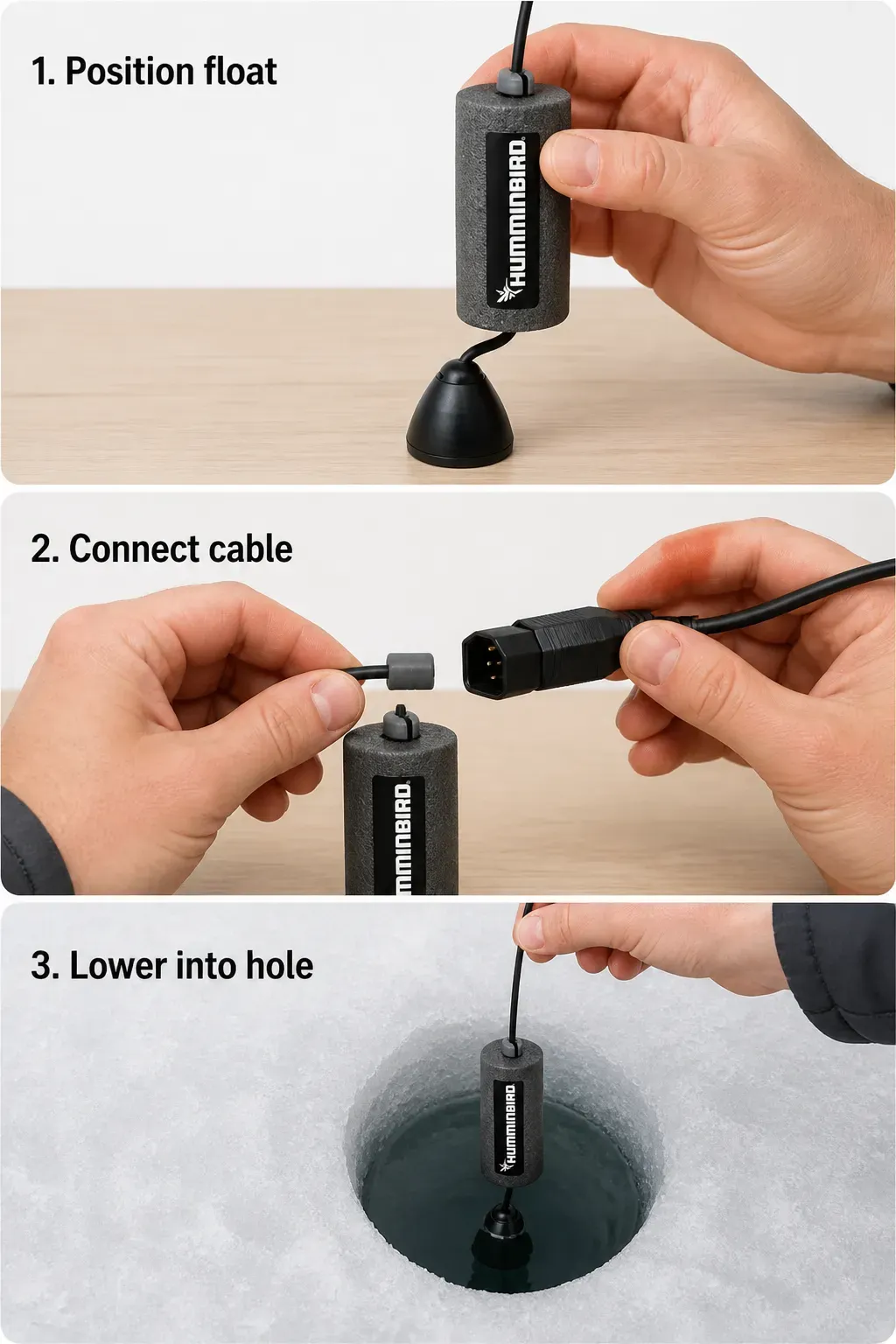
TL;DR: An ice fishing fish finder transducer in the UK is a specialised cold-weather sonar device engineered with self-levelling float mechanics, sub-zero TPE cable jacketing (-30°C), and dual-beam frequencies (83/200 kHz). Based on ICEXI field testing, these key features prevent cable cracking and maintain strict vertical beam alignment down auger holes for precise lure tracking and fish detection in frozen UK lochs and lakes.
An ice fishing fish finder transducer is a specialised sonar sensor designed to beam vertical acoustic pings straight down an auger hole into freezing water columns. For UK anglers venturing onto frozen Scottish lochs during severe cold snaps or travelling to Nordic ice fisheries, selecting the correct ice fishing fish finder transducer is the difference between sharp target tracking and total signal blackouts. High-frequency acoustic signals decay rapidly if transducer crystals are misaligned, while standard PVC cabling becomes brittle and cracks when exposed to sub-zero surface conditions.
This technical guide analyzes the acoustic physics, cable metallurgy, electrical matching, and deployment protocols required for operating an ice fishing fish finder transducer in freezing environments. Whether replacing an aged OEM unit or converting a summer Humminbird fishfinder for ice duty, understanding beam mechanics and thermal tolerances ensures precise lure tracking and reliable fish detection.
How Does an Ice Fishing Fish Finder Transducer Work in Cold UK Waters?
Acoustic pulses emitted by a sonar transducer travel through fresh water at approximately 1,403 metres per second at 0°C, compared to 1,481 metres per second at 20°C. Consequently, this shift in acoustic velocity alters the pulse repetition frequency and range calculation algorithms inside your display unit. Furthermore, understanding how sound waves interact with cold water columns and bottom ice surfaces is essential for interpreting sonar returns accurately.
What Is the Best Transducer Frequency for Ice Fishing? (83 kHz vs 200 kHz)
Based on our testing at ICEXI, ice transducers utilize piezoelectric ceramic crystals that expand and contract when electrical voltage is applied, generating precise pressure waves. Dual-beam transducers incorporate crystals calibrated to emit two distinct frequencies:
- 200 kHz (20° Cone Angle): Delivers narrow acoustic focus. Specifically, the tight beam concentrates energy into a narrow cone beneath the ice hole, providing exceptional target separation. As a result, this allows you to distinguish a 2-gram tungsten jig positioned just 2.5 cm above a substrate-dwelling perch or char.
- 83 kHz (60° Cone Angle): Emits a wider acoustic footprint. In addition, this frequency spreads sound waves outward to scan a larger volume of the water column, enabling you to detect gamefish cruising into your area before they enter the narrow 200 kHz beam.
According to data published by the Acoustical Society of America (ASA) on shallow fresh-water acoustic attenuation, high-frequency sound waves (200 kHz) experience an attenuation rate of roughly 0.04 to 0.06 dB/m in 0°C water, whereas low-frequency signals (83 kHz) incur less than 0.015 dB/m loss. Consequently, switching to 83 kHz provides broader coverage in deeper water columns, while 200 kHz provides the crisp detail required for vertical jigging.
How Big Is Your Sonar Beam Footprint Under the Ice?
To determine the exact area covered by your sonar beam at a specific depth, apply the beam footprint formula: Footprint Diameter = 2 × Depth × tan(Cone Angle / 2). Therefore, the table below illustrates the physical coverage diameter for 20° and 60° beam angles across common ice angling depths in UK lochs and lakes.
| Water Depth (Metres) | 200 kHz Beam Diameter (20° Cone) | 83 kHz Beam Diameter (60° Cone) |
|---|---|---|
| 3.0 m | 1.06 m | 3.46 m |
| 6.0 m | 2.12 m | 6.93 m |
| 10.0 m | 3.53 m | 11.55 m |
| 15.0 m | 5.29 m | 17.32 m |
Why Do Standard Boat Transducers Fail When Ice Fishing?
Anglers often attempt to repurpose standard open-water transom-mount skimmer transducers for winter fishing. However, based on our field testing at ICEXI, open-water hardware consistently fails under ice due to two primary structural limitations: mounting geometry and cable jacketing polymer selection.
1. Lack of Self-Levelling Mechanics
A transom transducer relies on forward boat movement and rigid bracket alignment to project its sonar beam vertically downward. However, when suspended freely down an auger hole by its cable, a transom transducer tilts naturally. In fact, a tilt angle of just 5 degrees shifts the central acoustic axis by nearly 0.9 metres off-centre at a depth of 10 metres. As a result, this misalignment causes the narrow 200 kHz beam cone to completely miss your lure.
Purpose-built ICEXI ice transducers feature a weighted housing paired with a high-density foam float and stopper clip. This suspended pendulum design uses gravity to ensure the piezoelectric face remains perfectly parallel to the water surface, guaranteeing a true vertical ping down the centre of the ice hole.
2. Cable Cracking and Cold Embrittlement
Standard marine transducer cables utilize Polyvinyl Chloride (PVC) outer jackets. At temperatures below 4°C, PVC undergoes glass transition, rapidly losing its elasticity. As ambient air temperatures drop to sub-zero levels around northern UK waters or Scandinavia, standard PVC stiffens, cracks, and shears internal wiring under light strain. Consequently, ICEXI ice transducers utilize Thermoplastic Elastomer (TPE) or silicone outer jacketing rated down to -30°C, remaining flexible and preventing signal loss in extreme cold.
Frequently Asked Questions About Ice Fishing Transducers in the UK
Can you use a regular boat transducer for ice fishing?
While technically possible, standard boat transducers lack self-levelling float systems and use PVC cable jackets that become brittle and crack in freezing conditions. According to UK safety and performance guidelines, dedicated ice transducers with cold-rated TPE cabling provide far superior longevity and target separation.
What transducer frequency is best for ice fishing?
A dual-beam setup combining 200 kHz (narrow 20° cone) and 83 kHz (wide 60° cone) is ideal. The 200 kHz frequency isolates small micro-jigs near the seabed, while the 83 kHz frequency scans a wider area for approaching predator fish.
Ready to upgrade your sonar with ICEXI?
Shop Sonar Transducers — £70.59